Introduction
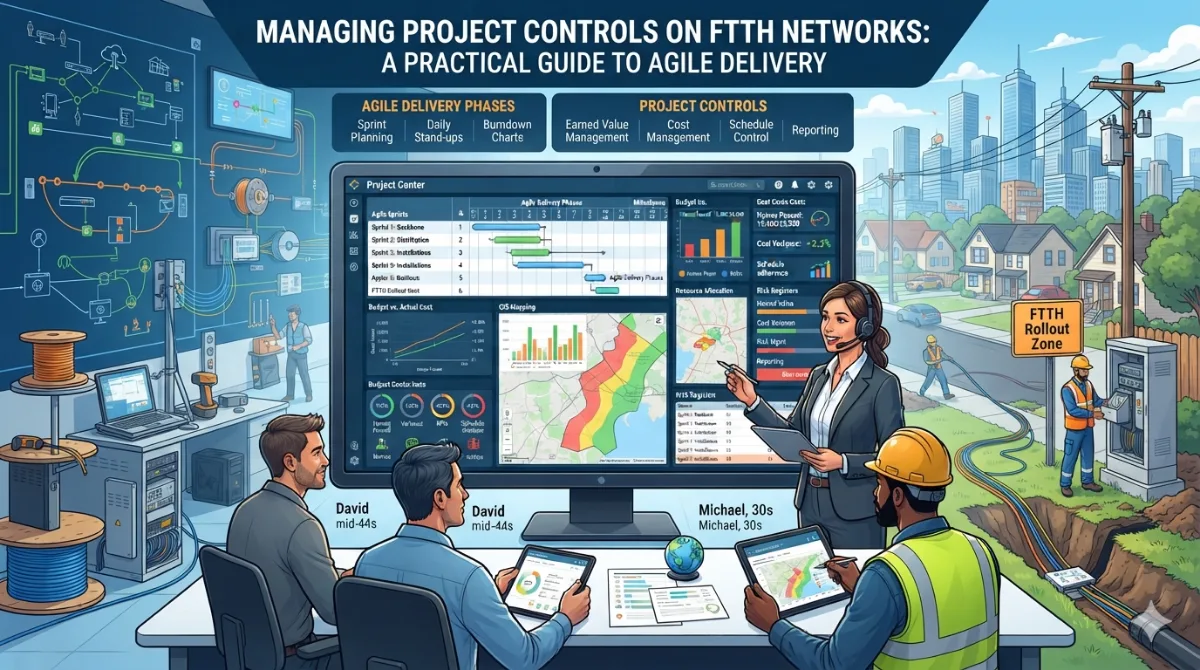
Fiber-to-the-Home (FTTH) rollouts are among the most operationally complex projects in the telecommunications sector. Unlike a typical software or infrastructure deployment with a defined scope and a single delivery site, an FTTH project unfolds across hundreds of geographically scattered work fronts simultaneously — permit approvals in one district, duct-laying in another, splicing crews finishing a third, and subcontractor invoices piling up for a fourth. For a Project Control Manager working on large carrier programs such as those run for Saudi Telecom Company (STC), the challenge isn't just tracking progress — it's building a control system that can absorb constant change without collapsing into chaos.
This article draws on real field experience managing project controls for STC FTTH deployments, and lays out a practical framework for applying Agile principles to a domain that, on the surface, looks nothing like software development.
Why FTTH Projects Resist Traditional Waterfall Control
Classic project control — baseline the schedule, track earned value, report variance, repeat — assumes that scope is stable and that the work breakdown structure won't shift dramatically once execution begins. FTTH rollouts break that assumption constantly:
- Permit dependencies are unpredictable. Municipal approvals for civil works can be delayed by weeks with no warning, and once granted, work must start immediately to avoid losing the window.
- Subcontractor capacity fluctuates. Civil and fiber subcontractors are shared across multiple projects and clients; their crew availability changes week to week.
- As-built conditions differ from design. OSP (Outside Plant) designs are based on desktop surveys and GIS data that frequently don't match what crews find on the ground — utility conflicts, road conditions, or building access issues.
- Client priorities shift. STC, like most large operators, reprioritizes coverage areas based on commercial targets, competitive pressure, or regulatory commitments, sometimes mid-quarter.
A rigid waterfall control structure treats each of these as an exception to be escalated. In a network rollout spanning dozens of clusters, exceptions are not exceptions — they are the normal operating condition. This is where Agile thinking earns its place, not as a software methodology imported wholesale, but as a mindset adapted to civil and telecom field realities.
Reframing Agile for a Physical Infrastructure Project
Agile in software works because the unit of delivery — a user story, a sprint increment — is abstract and can be redefined quickly. In FTTH, the unit of delivery is physical: a section of duct, a cabinet, a splice closure, a set of homes passed. You can't "refactor" a trench. But the underlying Agile principles still transfer well when mapped correctly:
1. Break the network into small, deliverable increments
Instead of managing "the FTTH project" as one monolithic program, the network is divided into clusters or zones — typically defined by cabinet or Primary/Secondary distribution area boundaries — each representing a self-contained, independently trackable unit of work. Each cluster becomes the FTTH equivalent of a sprint deliverable: it has a defined scope (homes passed, meters of duct, number of closures), a target completion date, and clear acceptance criteria (as-built approval, QA sign-off, RFS — Ready for Service — status).
This decomposition is the single most important control decision on the project. It converts an overwhelming, months-long program into a series of two-to-four-week delivery cycles that can be planned, tracked, and closed independently — much like sprints, but bound by geography rather than backlog items.
2. Run short planning and review cycles per cluster
A practical rhythm that works well on FTTH programs:
- Weekly cluster planning session — civil, fiber splicing, and permit teams align on which clusters move into active execution based on permit readiness and subcontractor capacity.
- Bi-weekly review — completed clusters are walked through against acceptance criteria (design vs. as-built variance, QA punch-list closure, safety incidents), similar to a sprint review.
- Retrospective on blocked clusters — clusters that stalled get a short root-cause discussion: was it a permit delay, a subcontractor resourcing issue, a material shortage, or a design error? This feeds directly into the risk register and into how the next planning cycle allocates resources.
This cadence gives leadership a live, granular view of progress instead of a single aggregate percentage that hides where the actual bottlenecks are.
3. Maintain a prioritized backlog of clusters, not a fixed master schedule alone
A master schedule is still necessary for the client and for milestone commitments, but it should sit on top of a living backlog of clusters ranked by:
- Permit readiness
- Commercial priority (competitive coverage, pre-sold demand)
- Subcontractor mobilization efficiency (grouping geographically adjacent clusters to reduce mobilization cost)
- Risk exposure (utility conflicts, right-of-way disputes)
When a permit gets delayed or a subcontractor underperforms, the response isn't to freeze the whole program — it's to pull the next-ready cluster up the backlog and keep crews and reporting moving. This is the direct FTTH analog of a product backlog reprioritization, and it's what prevents a single blocked area from stalling program-wide productivity metrics.
4. Make the SQL/reporting layer reflect reality in near real time
None of the above works without a data layer that can be trusted. In practice, this means:
- Work order and material transaction tracking needs to reconcile automatically with completion claims — a common failure point is contractor ID mismatches or foreign key errors between work orders and material issuance/return records.
- Dashboards should report at the cluster level, not just the program level, so that a Projects Director can see which of the 15 active clusters are on track, which are blocked, and why — in one view.
- Financial performance views (cost-to-complete, subcontractor payment recalculation, variance by cluster) need to update on the same cadence as the physical progress reporting, or cost control lags behind execution and surprises show up too late to correct.
Building an internal portal — with modules for material management, work order tracking, subcontractor payment, and financial dashboards — is what makes this level of granularity sustainable across a program with dozens of concurrent clusters and multiple subcontractors.
Common Pitfalls and How to Avoid Them
Treating "Agile" as an excuse for no schedule. Agile clusters still roll up into a binding master schedule and client-facing milestones. The backlog gives execution flexibility; it doesn't remove commercial accountability.
Letting cluster boundaries drift. If cluster definitions aren't locked early (same PDA/cabinet boundaries used consistently across design, execution, and billing), progress reporting becomes inconsistent and reconciliation across teams breaks down.
Ignoring subcontractor capacity as a first-class planning input. Many FTTH schedule slippages don't originate from design or permits — they originate from a subcontractor being stretched across three clients at once. Capacity should be tracked and planned with the same rigor as permits.
Over-centralizing status updates. If site engineers and subcontractor foremen can't update cluster status directly (via a simple portal or mobile-friendly form), the control team ends up chasing data instead of analyzing it. Self-service status updates, validated by QA sign-off, keep the reporting loop fast enough to be useful.
Losing the retrospective discipline. It's tempting to skip retrospectives when the team is under schedule pressure, but this is exactly when they matter most — recurring blockers (a specific municipality's permit office, a specific subcontractor's crew shortage) only become visible with a structured, repeated look-back.
Conclusion
Agile methodology, applied literally, doesn't fit a fiber rollout — there are no sprints of abstract story points, no product owner reprioritizing a backlog of user stories. But the underlying discipline — decompose the work into small deliverable increments, plan and review in short cycles, keep a prioritized and reprioritizable backlog, and build a data layer that reflects ground truth quickly — maps remarkably well onto FTTH execution. For a Project Control Manager on a large carrier program, the real skill isn't choosing between Agile and Waterfall; it's building a control system where the master schedule provides commercial accountability while cluster-level Agile cycles provide the operational flexibility that field conditions demand every single week.